
Golf Cart Insurance in Arizona: Street-Legal LSVs, Community Streets, and Liability
Golf cart insurance in Arizona starts with one question: is your cart a golf cart, a street-legal low-speed vehicle (LSV), or something else? The answer decides whether your homeowners policy may help, whether you need a separate cart or auto-style policy, and what happens if someone is hurt. Many East Valley owners drive carts on community streets every day without knowing which category they are in.
We are Howard Castle Insurance, Independent Agents based in Gilbert. We compare cart, LSV, and related coverage across 40+ carriers. This article explains how carts are typically insured in Arizona and the questions worth asking before you drive yours out of the garage.
Golf cart, LSV, or off-road UTV: why the label matters
Carriers insure these vehicles differently, so the label matters. A standard golf cart is built mainly for the course and private property. A street-legal LSV is built with safety equipment for certain public roads and is generally registered and titled. A UTV or side-by-side is an off-road vehicle with its own coverage rules.
How to tell what you have:
- Golf cart: Usually no title or registration, built for low speeds, and used on a course, private property, or community paths.
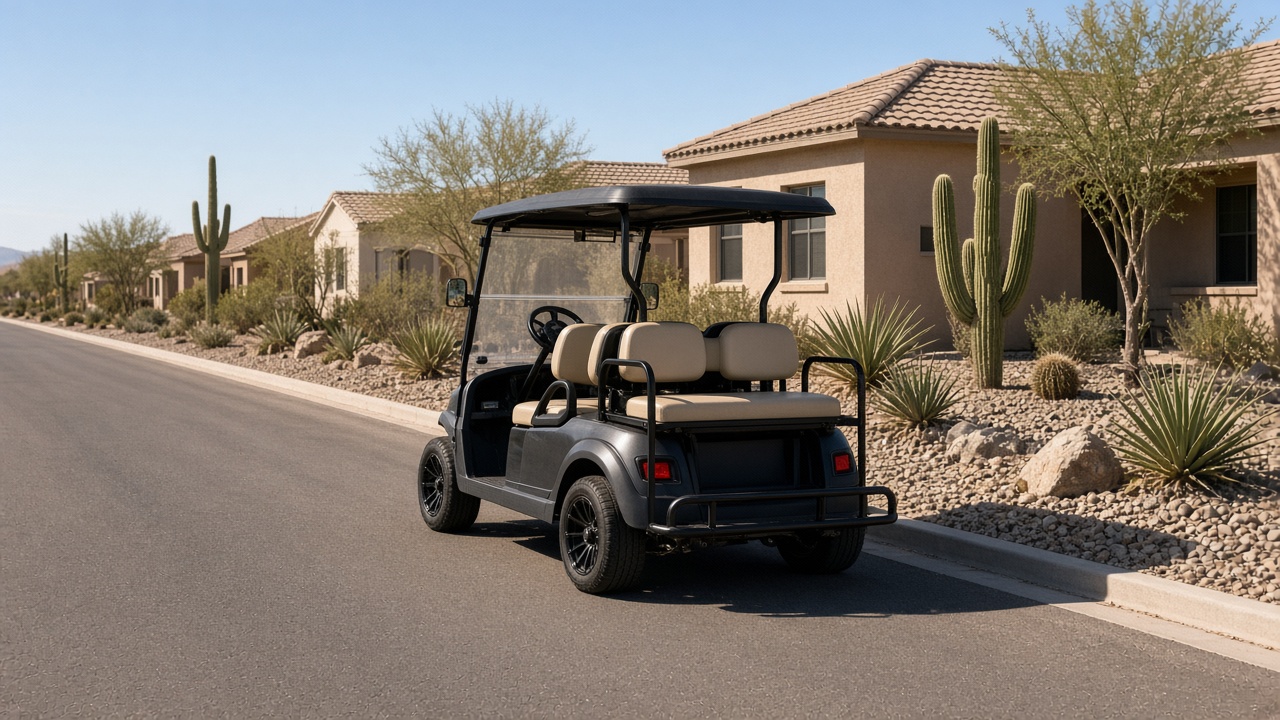
- LSV: Typically has a VIN, headlights, turn signals, mirrors, seat belts, and a windshield, and is registered for road use.
- Modified cart: A golf cart with added lights or speed upgrades is not automatically an LSV. Registration and equipment requirements still apply.
Check your title, registration, and the manufacturer's label. Arizona MVD and your city set the rules on registration and where carts and LSVs may go, so check with them for your vehicle.
Is a UTV the same thing?
No. A UTV or side-by-side is built for off-road use, and most carriers insure it as an off-road or recreational vehicle, not as a golf cart. If you have both a cart and a UTV, expect separate coverage for each. The parallel is similar to motorcycles: a car policy usually does not extend to them, as our motorcycle insurance article explains.
What a homeowners policy may do for a cart — and where it stops
Homeowners policies often give limited coverage for golf carts, typically while the cart is on your property or on a golf course. Many policies may exclude a cart used on public roads, and an LSV registered for road use is usually outside a homeowners policy altogether.
Where homeowners coverage commonly stops:
- Road use: Driving on public streets may fall outside homeowners coverage.
- Off-premises use: Driving through your neighborhood or community, not on a course, may not be covered.
- Physical damage limits: Coverage for the cart itself, if any, may be small or subject to the property deductible.
- Liability: Liability for injuries caused by the cart may be limited or excluded off premises.
Read your homeowners policy for "motorized land vehicle" or "golf cart" wording, or ask us to review it. Our home insurance page and our article on home insurance in Gilbert and Mesa cover the home side.
Driving on community streets and public roads
Many East Valley neighborhoods are built around carts. Sun Lakes near Chandler and other 55+ communities, plus master-planned communities in Gilbert and San Tan Valley with cart paths, see carts on the streets every day. But a community street is not always a private road.
Some community streets are public roads. Others are private. The difference can matter for both the law and your coverage. A cart that is covered on a cart path may not be covered on a public street running through the same neighborhood.
Questions to settle:
- Are the streets you drive on public or private?
- Is your cart registered as an LSV, or is it a golf cart?
- What do your city, Arizona MVD, and your community's own rules allow?
- Does your policy cover the places you actually drive?
Community rules on carts vary. Read your community's rules directly rather than relying on a neighbor's summary.
If you are not sure which coverage fits how you use your cart, call our Independent Agents at (480) 500-7911.
Liability when a grandchild, teen, or guest drives
Liability is often the most important part of cart coverage. If someone else drives your cart and hits a pedestrian, another cart, or a car, you may be looking at a claim. Whether your policy covers that driver depends on its permissive-use terms.
Questions to ask about permissive use:
- Does the policy cover anyone you allow to drive, or only listed drivers?
- Are there restrictions based on a driver's age or license status?
- Does coverage apply to visiting family, such as grandchildren during the holidays?
- What are the liability limits, and are they high enough?
We do not give legal advice on who may drive a cart. Check local rules, and ask us how a specific policy treats permissive drivers. If you have significant assets, it is also worth asking how cart liability fits with the rest of your coverage.
Lifted carts, lithium batteries, and custom parts
Many Arizona carts are upgraded with lift kits, custom wheels, upgraded seats, sound systems, or lithium battery packs. These parts can add real value, and many policies cover only what is declared or standard.
Questions to ask:
- Declared value: Can you list the cart's full value, including upgrades?
- Custom parts coverage: Is there a separate limit for accessories and modifications?
- Batteries: Are lithium batteries covered as part of the cart, and for what kinds of loss?
- Fire: How does the policy treat fire damage to the cart, and to the garage or home if a battery fails?
Lithium batteries carry a fire risk, especially when charged in a hot garage. Arizona summer heat can shorten battery life and strain charging systems. Follow the manufacturer's charging instructions, and keep receipts for the battery and any upgrades.
Theft and storage in garages, carports, and parks
Carts are easy to move and are a common target for theft in some communities. Where you store the cart, and how you secure it, can matter to a carrier. Theft coverage depends on the policy you have.
Storage situations we hear about:
- Garage: Usually the most secure. Ask how charging in the garage affects your home and cart coverage.
- Carport: Easier for thieves to reach. Locks, wheel locks, and removing the key help.
- Winter parks: Many winter residents in Mesa and Yuma keep a cart at a park or resort. Ask whether coverage applies at that location and while you are away for the summer.
Keep photos of your cart, its serial number or VIN, and receipts for upgrades. Those make a theft claim easier.
How our Independent Agents shop cart coverage
We compare cart and LSV options across 40+ carriers. Some carriers write stand-alone golf cart policies. Some write LSVs on an auto-style policy. Others may add limited cart coverage to a home policy. We look at how you use the cart and match it to the right type.
Before you call, have ready:
- Make, model, year, and serial number or VIN
- Whether it is registered as an LSV
- Upgrades, batteries, and their value
- Where you drive it and who drives it
- Where it is stored
- Your homeowners and auto declarations pages
Learn more on our auto insurance page, or see our Chandler, Gilbert, and Mesa service pages. Visit our FAQ or contact page with questions.
Call Howard Castle Insurance at (480) 500-7911 to compare quotes from 40+ carriers with our Independent Agents.
FAQ
Does my Arizona homeowners policy cover my golf cart?
It may, in a limited way. Homeowners policies often give some cart coverage on your property or a golf course. Many policies may exclude road use and limit liability off premises. Check your policy's wording or ask us to review it.
Do I need separate insurance for a street-legal LSV?
Usually, yes. A registered LSV is typically insured on its own policy, often auto-style, rather than under homeowners. Ask how your carrier writes LSVs.
Am I liable if my grandchild crashes my cart in our community?
You could face a claim. Whether your policy covers a grandchild or guest depends on its permissive-use terms and limits. Ask us how a specific policy treats permissive drivers, and check local rules on who may drive.
Are lift kits and lithium batteries covered?
Sometimes. Many policies cover only declared or standard equipment. Ask about declared value and a custom parts limit, and keep receipts.
Is a UTV the same as a golf cart for insurance?
No. A UTV or side-by-side is usually insured as an off-road or recreational vehicle, separately from a golf cart.