
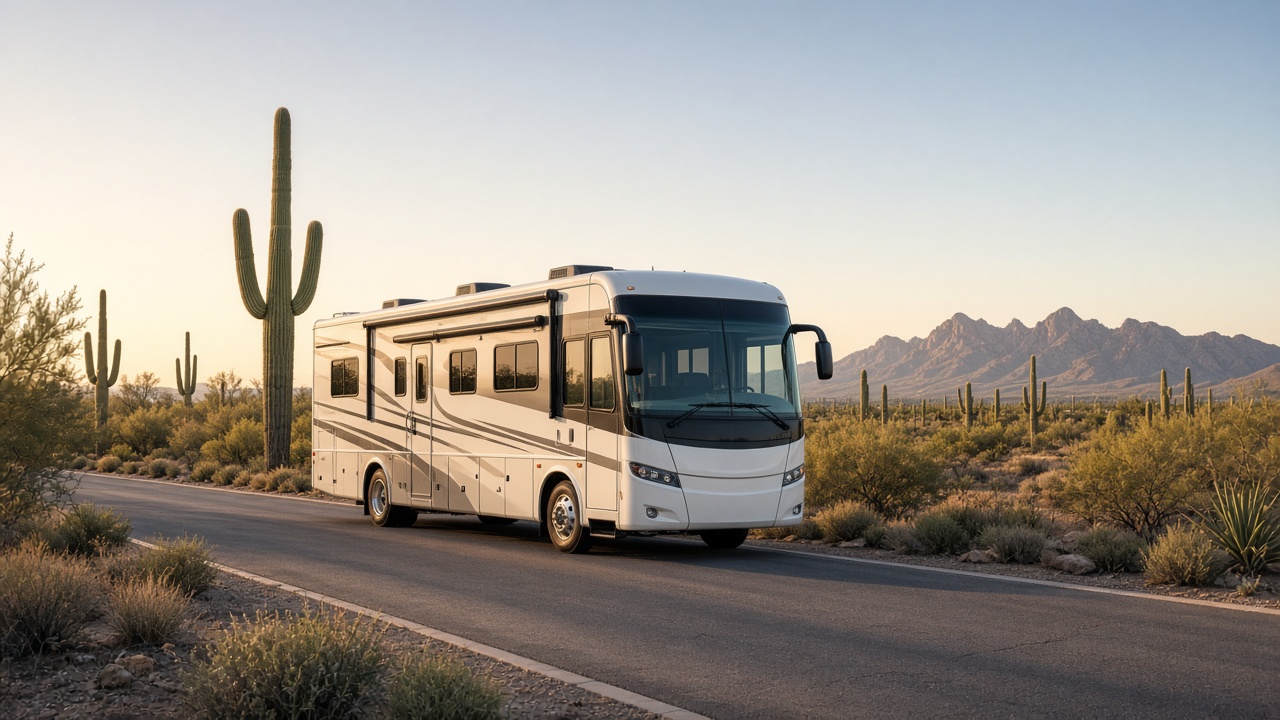
RV insurance in Arizona is the specialized coverage motorhome and trailer owners use to protect the rig, liability, personal effects, and campsite exposure — whether you drive a Class A, B, or C motorhome, tow a travel trailer or fifth wheel, winter in Mesa as a snowbird, or store through summer heat. At Howard Castle Insurance in Gilbert, Arizona, we are Independent Agents who shop RV markets across 40+ carriers when an auto policy clearly is not enough.
For a shorter product overview, see our RV insurance page. Tow-vehicle questions often sit next to auto insurance. Boats are a separate marine line — see boat insurance.
“RV” covers two different underwriting stories. Mixing them up leaves gaps.
Motorized RVs — Class A, Class B (camper vans), and Class C motorhomes — drive on public roads under their own power. They generally need motor-vehicle liability like other vehicles, plus physical damage and the RV-specific coverages below.
Towables — travel trailers, fifth wheels, pop-ups, and toy haulers — are pulled by a truck or SUV. Liability while the trailer is being towed often follows the tow vehicle’s auto policy. Physical damage to the trailer itself is not free on that auto policy. That is why a dedicated RV or trailer policy exists.
We write for motorhomes, travel trailers, fifth wheels, full-timers, weekend warriors, and snowbirds parking for winter in Mesa or storing through desert heat. Bring year, make, model, length, use, and where the rig lives when parked.
Motorhomes. A motorhome on Arizona public roads is generally treated like other motor vehicles for financial responsibility. Arizona’s current minimum liability limits are 25/50/15: $25,000 bodily injury per person, $50,000 bodily injury per accident, and $15,000 property damage per accident. Those are legal floors, not recommended ceilings — a Class A can easily outrun them. Lenders and storage facilities often require higher liability and proof of physical damage.
Travel trailers and fifth wheels. Requirements hinge on how the unit is plated and used. Liability while towing typically rides with the tow vehicle; the trailer’s own physical damage still needs a dedicated conversation. Ask us (and Arizona MVD if plating is unclear) how your unit is titled — do not invent a weight-based rule from a blog. Skipping a dedicated RV form because “the truck covers it” is the most common towable mistake we see.
An RV is a hybrid — part vehicle, part home. A standard auto policy is built for cars and light trucks, not for awnings, appliances, plumbing, satellites, campsite liability, or emergency expense far from home.
Gaps that show up constantly:
You can sometimes schedule an RV on an auto policy. We usually advise against relying on that alone. For the tow vehicle, start with auto insurance or our car insurance in Gilbert, AZ guide, then quote the RV as its own line.
Arizona use is not generic Midwest camping. Extreme heat, monsoon hail on outdoor storage, dust, theft at storage lots, and pest damage show up every year. Exact forms vary by carrier; we compare markets rather than promise one universal policy.
Total-loss replacement matters when a relatively new motorhome or trailer is totaled. Instead of paying depreciated ACV, the form aims to replace with a new comparable unit within the carrier’s eligibility window.
Actual cash value (ACV) pays replacement minus depreciation. Soft quotes can look cheaper until a total loss pays thousands less than it costs to get back on the road. Ask which valuation your quote uses before you bind. We do not invent sample insured values or “Arizona average RV premiums” here.
Original-owner and association discounts (Good Sam, AAA, FMCA, and similar) are ask-your-agent items — some carriers honor them; none get a fake percentage in this article.
Vacation liability responds when the parked RV is acting like a temporary home — a guest injured at the campsite or certain third-party claims tied to the rig off the public road. That differs from highway liability while driving.
Personal effects covers belongings inside the RV subject to limits and valuation. Emergency expense helps with lodging and transportation when a covered breakdown or loss strands you away from home. Mileage thresholds and daily caps vary — read the form.
Recreational / pleasure use assumes you still have another primary residence. Full-timer coverage is for people who live in the RV for extended periods (often framed around six-plus months a year on carrier applications). It typically adds personal-liability protection closer to a homeowners-style conversation and higher contents limits — critical if the RV is your only home. Snowbirds on long winter stays in Mesa should not silently stay on a “weekend warrior” use class.
Arizona storage is its own underwriting story:
Every winter, owners roll into Mesa, the East Valley, and snowbird corridors with a northern plate and a southern parking plan. Local context: Mesa insurance services, Gilbert insurance services, and a light nod to the Yuma corridor. Phoenix-metro owners can also start with Phoenix insurance services.
What usually changes: honest use class for extended winter living; continuous comprehensive while parked; solid contents and vacation liability; aligning the tow vehicle and trailer so liability and physical damage do not leave a hole; and a lay-up / storage plan when you fly north — not a lapsed policy.
We do not invent a product named “snowbird endorsement.” Carriers handle seasonal Arizona use through use class, garaging, lay-up, and specialty RV forms — we shop those facts across markets.
Usually no on a personal RV policy. Personal motorhome and trailer policies typically exclude peer-to-peer rental — platforms like Outdoorsy and RVshare. Renting without the right commercial or rental market in place can void coverage when a claim hits. If you plan to rent the RV out, say so up front. We will not imply that Howard Castle Insurance can silently paper over uninsured P2P rental use.
RV markets are specialty. Not every auto carrier writes motorhomes and fifth wheels well. As Independent Agents based in Gilbert, we compare options across 40+ carriers instead of locking you into one brand’s appetite for Class A length, full-timer liability, pest, or lay-up.
Bring year, make, model, length, motorized vs. towable, pleasure vs. full-timer / snowbird use, where the rig is parked, and any lender or storage proof requirements. Bundle RV with auto or home when the markets allow. Review the tow vehicle under auto insurance and dwelling coverage under home insurance when it helps. For statewide auto cost context only, see average car insurance cost in Arizona; RV premiums stay quote-specific.
Call (480) 500-7911 (Mon–Fri 8am–5pm MST). Tell us the unit type (Class A/B/C, travel trailer, fifth wheel, toy hauler), year/make/model, how you use it, where you park or store it, and whether a lender or storage yard needs specific limits.
We are Gilbert-based Independent Agents serving Arizona RV owners across 40+ carriers. For general questions, see our FAQ or contact page. Product overview: RV insurance.
A motorhome driven on Arizona public roads generally needs motor-vehicle liability like other vehicles. Arizona’s current minimum liability limits are 25/50/15 ($25,000 bodily injury per person / $50,000 per accident / $15,000 property damage). Lenders and storage facilities often require higher limits and physical-damage proof. Call (480) 500-7911 with the unit details.
Liability while the trailer is being towed often follows the tow vehicle’s auto policy. Physical damage to the trailer — and RV-specific items like awnings, personal effects, vacation liability, and emergency expense — usually need a dedicated RV or trailer policy. See auto insurance for the tow vehicle and RV insurance for the trailer.
Snowbirds wintering in Mesa and similar East Valley parks often need continuous comprehensive while parked, honest use-class disclosure (pleasure vs. extended / full-timer liability), solid contents and vacation-liability limits, and a storage or lay-up plan when the season ends. There is no single invented “snowbird endorsement” — we shop specialty RV markets against how many months you actually live in the rig.
Physical-damage / comprehensive coverage is the usual tool for hail and many outdoor-storage losses, subject to the form and deductibles. Heat-related wear, maintenance issues, and pest/rodent damage are often limited or excluded on standard forms — specialized RV policies can add pest protection Arizona owners should ask about. Covered vs. uncovered storage is an agent question, not a promised discount.
Personal RV policies typically exclude peer-to-peer rental (Outdoorsy, RVshare, and similar). Renting without the right commercial or rental coverage can void the policy. Tell us before you list the rig so we can point you to the correct market.
We shop top carriers including



































Have questions? Need a quote? We're here to help. Reach out and let's find the perfect coverage for you.
Mon-Fri: 8:00 AM - 5:00 PM MST
Saturday & Sunday: Closed
Gilbert, Arizona
Proudly serving all of Arizona
Get a free quote from 40+ carriers in minutes. No obligation, no pressure—just great coverage options.
Get Your Free QuoteFill out the form below and we'll get back to you as soon as possible.